Working out or doing some form of exercise every day? Or do you seem to have migrated somehow to a 6 on 1 off type of regime? Have you found that you’re having trouble avoiding the inevitable guilt that accompanies a rest day? Are you doing too much exercise?
You’re not alone. So many people that I know and talk to in the gym describe the same symptoms.
Let’s call it FOME… Fear Of Missing Exercise….or FORD… Fear Of Rest Days. Although I think FORD is taken…
Anyway…
It’s not a bad thing to keep moving every day. Our gadgets and gizmos are constantly nagging us to complete those 10 thousand steps every day. Have a drink. You’ve been sitting down too long – move around…and that’s great. Nobody wants to feel too lazy.
But there are an alarming number of us that seem to have convinced ourselves that we should be doing more. Because more is better, right?
Come on…we are educated people, especially when it comes to our exercise regime. It’s planned. We know what we’re doing and when…and why (more often than not). And because we know all that, we also understand that rest is important.
We know that rest helps rebuild your muscles allowing them to adapt and grow back bigger and stronger. But there are often times when we may try and push it too hard by doing too much exercise.
This phenomenon of exercising too much has an industry term that we’ve all heard of (yet are convinced that we’ve never suffered from) – overtraining.
It’s accepted that most athletes of all levels may have experienced it at some point in their lives (whether they are aware of it or not) and the results can be catastrophic, sending you backwards as opposed to driving you toward your fitness goals faster.
Overtraining can manifest itself in many ways, the most obvious include hitting plateaus in your training, unwanted weight loss/gain and the sapping of energy and motivate to even want to exercise at all.
Those are just the basic indicators or signs you have been exercising too much – how else can you know that you might be training too much?
Below are 10 possible warning signs of doing too much exercise and that you might be overtraining:
- Low energy levels in general
- Early onset of fatigue when actually training
- You might be feeling more irritable than normal
- Higher Resting Heart Rate than usual
- On a similar note, your Heart Rate Variability might be low
- Your motivation got up and went
- Your performance has plateaued…and you seem to have hit a wall
- You might be losing weight without meaning to
- Muscle soreness lasting longer than normal?
- You are constantly ill
1. Low energy levels in general.
If you’re feeling super fatigued and have suffered from low energy levels for days then you’re probably doing too much exercise.
You need to rest, or expect your performance to remain mediocre (or even drop off a cliff).
2. Early onset of fatigue when actually training.
Feeling an overall sense of fatigue after a session of intense training is normal. Feeling unusually tired early on in your workout isn’t. It’s one of the telltale signs you have been exercising too much.
3. You might be feeling more irritable than normal.
Agitated? Short tempered? Easily irritated?
If you’re experiencing any one of these symptoms, you can more or less guarantee that you’re exercising too much.
Take hold of yourself (and spare the people around you) by taking a few days off here and there. You’ll feel back to your normal self in no time.
4. Higher resting heart rate than usual.
If you are classed as a really fit person, generally, you would expect a resting heart rate that is sub 50 or 60 bpm or so (the average person’s resting heart rate is around 72 bpm).
Do you Check yours regularly? If you’re in great shape but your resting heart rate is higher than you would expect, you might be doing too much exercise and it might be time for an exercise break.
If you don’t already, you might consider wearing a fitness watch or monitor to measure your recovery and other stats. There are plenty of great options out there.
5. On a similar note, your heart rate variability (HRV) might be low.
While you want your resting heart rate to be fairly low, you actually want your heart rate variability (HRV) to be higher. What is HRV you might ask.
Well, simple measures of the small changes in each beat of your heart can provide a wealth of information on the health of your heart and nervous system, Such measures are called heart rate variability or HRV.
Having a high HRV is a sign that your body is recovering well from stress (which can include your workouts). Conversely, low HRV is usually a sign that your body isn’t recovering well. Training and doing too much exercise can result in poor recovery, and a low HRV will show it.
Again, there are devices that measure HRV these days and they are fairly accurate. Discover more about HRV
6. You’re motivation got up and went.
If you’re a serial exerciser like I am but you’re at a stage where you are less and less motivated to do your work out, it could be your body signifying that you actually need some time off.
A few days (or maybe a week – yes really…a whole week) can see your motivation return. It may also be that you just need a bit of time away from your regular intense training regime. You could try swapping up your usual workouts for other totally different activities such as walks or other sports for example. A friendly game of tennis or badminton. Just something completely new. You’ll feel like you are filling your time with something new and worthwhile. Often, you’ll benefit from a break mentally as well as physically. Don’t let overtraining get you. Recognise that lack of motivation can be one of the classic signs you have been exercising too much.
7. Your performance has plateaued…and you seem to have hit a wall.
It doesn’t seem to matter how much effort you put in. How hard you train. How much work you put in. There’s no improvement. In fact, you might be in reverse.
Well done: you’ve officially plateaued. Hit that wall. You’re done.
It’s a classic indicator of overtraining.
What should you do to get your training back on track? It always seems so counter-intuitive doesn’t it?…but you guessed it. Take a breather. Rest up. Enjoy a few days off to recharge. Because you’ll never make progress without the right recovery. You’ve been doing too much exercise – and not enough resting.
8. Are you losing weight without meaning to?
Whilst many “non-trainers” would love to lose a few extra pounds without trying, if you seem to be losing weight and maybe even a decreased appetite (and you’re not actually on a diet), it may be due to overtraining manifesting itself.
It’s extremely important to back up your training with great nutrition, making sure to get all of the vitamins and such that your active body requires. Training, nutrition and rest – they are the 3 cornerstones. Doing too much training or overtraining isn’t.
9. Muscle soreness that lasts longer than normal.
Unless you haven’t trained for a while (which almost always results in acute muscle soreness for a period – I know), prolonged muscle soreness can be a sign that you’re exercising too much.
Post heavy or intense training, your body has to have adequate time to recover and persistent soreness means it’s not getting that optimal chance to do just that. Recovery is key. Why would you want to take two steps forward…and two steps back? That’s a dance you don’t want to master…
Rest, recuperate…and be ready to attack your next session.
10. You are constantly ill.
I’m sure that we all suffer from a sniffle or a mild cold here and there. Probably just like you, however, I’m hardly ever sick. I think we can put that down to regular exercise and good nutrition…this supports a great immune system and all the other traits that fitter people tend to enjoy.
So if you find that you are getting sick more than usual, or generally just feel pretty crappy and fatigued overall, I think that you’d better consider taking that break as you’re probably doing too much exercise. You’ll thank yourself for it later.
How to Prevent Overtraining
Everyone is different when it comes to how much training is too much. We all have different levels of tolerance for the multitude of sports and exercise that we do. But we are all susceptible to doing too much exercise. After reading the above symptoms it might be obvious what we can do to prevent overtraining from happening but I’ll outline some tips below anyway…
Time off every so often is a must. Many fitness industry professionals strongly believe you should take an entire week off of training every few months or so to let your body recuperate.
I never used to do this and I was training 7 days a week, 6 on one off if I was being “good” to myself. I always thought I’d look terrible and feel worse if I took any time off. The guilt would be too much to handle.
I can advocate for it now because I practice what I preach. I am a complete convert after suffering numerous repetitive injuries to ligaments and tendons through what I now consider over-use. When my training is going particularly well I now know it’s time to take a short time off – not try and push for even greater results. After all, if training is great this week…it’ll be even better next week won’t it?
More often than not…no, it won’t. If you are on the tip of a curve, the only way is down. And doing too much exercise will push you off that cliff.
The bottom line is that if you’re experiencing multiple symptoms of overtraining, try resting.
If you can’t bring yourself to completely take time off, then maybe do some alternative active rest day activities instead.
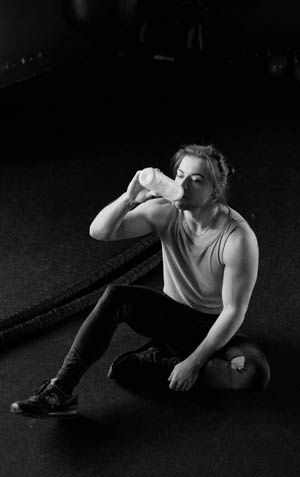
Drink more. Especially if you are sweating more than normal – perhaps the weather is hotter or you are pushing harder. Replenish your body’s stores of electrolytes. Drink, drink, drink.
As well as supporting every process in the body, water also aids recovery. And remember, the whole point of this article is centred around recovery. Proper recovery should be as much a priority as proper training is to you.
Have sore muscles? Help them to recover with all the plays in the playbook. A good warm down. Stretching. Foam Rolling. Massage. Relaxing baths. Whatever you can do to help.
Get adequate sleep. Easy to say with the prevalence of sleep problems that abound. I have problems sleeping myself but as outlined in another article, there are things you can do to try and help the situation. Without enough sleep, you’ll never perform to your max in exercise or life in general.
Don’t be afraid to take a cat nap. I used to fall asleep for a couple of minutes on the bench press when I was younger and training like a superhero (those were the days!) but as you get older, it’s an unavoidable fact that you get more tired after less effort. Go with it. I’m not suggesting buying a rocking chair…but recognise that it might be beneficial to let yourself snooze for a short while. Have a nap. It’s a culture thing in some countries. Siesta. Don’t feel guilty – it’s not all day.
Feel better in yourself. Feel better about yourself. Take a day off…